Since the outbreak of the Iran conflict in spring 2026, heating oil prices in Germany have risen by more than 60 percent. The Strait of Hormuz, through which around 20 percent of the world’s oil is transported, is barely passable for tankers. Gas prices are following the same trend. What long seemed theoretical – a supply gap that hits you directly at home – is now a reality for many households.
A heating failure in winter comes in many forms: a burst pipe, a broken pump, a blackout, a boiler giving out, or simply no heating oil left in the tank. The result is the same. The question is: how long can you manage, and with what means?
This article goes through the options from cheap to expensive – honestly, with concrete product recommendations and without glossing over what’s dangerous.
# Why Heating Systems Fail
The most common causes are technically fixable – but not immediately:
Technical defects are the most frequent cause. Circulation pump, expansion vessel, ignition electrode – many components of a heating system can fail. In winter, heating engineers are in short supply, and waiting times of several days are normal.
Blackout or power failure knocks out every modern gas boiler. Oil and pellet systems also need electricity for the pump and controls. Only very old gravity-fed systems run without power.
Supply disruptions – whether from price explosions, delivery bottlenecks or geopolitical crises – affect primarily older oil heating systems with a poorly-filled tank.
Frost-induced pipe damage can put the entire heating system out of action.
In all these cases: your home cools down more slowly than you might think, if you act quickly.
# Immediate Measures – Free
Before spending money, get the maximum out of what you already have.
Retain heat rather than generate it. A well-sealed home loses heat slowly. Close all doors to unused rooms and focus on a single space. A 20 m² room is far easier to keep warm than an entire flat.
Block draughts. Window frames, door gaps and roller shutter boxes are the biggest sources of heat loss. Towels under doors, tape or foam strips help immediately.
Curtains and blankets over windows. Thick curtains significantly reduce heat loss through windows – especially at night. Alternatively, temporarily tape a woollen blanket to the window frame.
Rugs on cold floors. A large proportion of heat is lost through the floor, especially in ground-floor flats.
Use body heat. Stay together in one room, wear multiple layers, use a sleeping bag. It sounds trivial, but it’s the most effective free measure available.
Eat warm. Hot meals and drinks help your body maintain its core temperature – and they can be prepared with a camping stove or Esbit cooker, even if power and heating have both failed.
Tea light heater? The classic flower pot and tea light construction has been doing the rounds on social media for years. Honest assessment: it generates no additional energy – three tea lights remain three tea lights (~120 watts, less than an old light bulb). The terracotta pot stores the heat and releases it as radiant warmth instead of letting it rise straight to the ceiling. At close range (30–50 cm) you’ll feel a difference; on room temperature it has no measurable effect. Useful for warming your hands or as a psychological comfort – not as a heater. An honest test on YouTube (German).
# Thermal Clothing – The Underrated Option
Before turning to technical heating solutions, there’s a strategy that almost nobody plans for consciously: the right clothing.
A person in good thermal underwear needs less ambient warmth. That sounds simple, but it makes a measurable difference when you need to maintain 15 degrees Celsius in your home instead of 21.
Merino wool is the gold standard here: it insulates even when slightly damp, barely itches, and regulates temperature better than synthetic fibres. The Danish brand DillingAnzeige produces high-quality organic merino underwear at fair prices – for women and men. If you want more choice: IcebreakerAnzeige (New Zealand) is one of the best-known merino brands worldwide; SmartwoolAnzeige comes from the outdoor world and tends to run slightly thicker. Engel NaturAnzeige is a German brand with a long tradition, combining wool and silk – particularly well suited for sensitive skin.
The principle: merino base layer directly against skin, regular clothing on top, a thick jumper over that. These three layers provide more warmth than a room temperature increase of 3 degrees Celsius.
Round it out with warm socks (wool, not cotton), a hat (20–30% of body heat is lost through the head) and a decent sleeping bag for the night.
# Affordable Electrical Solutions (Under €60)
When power is available, simple options open up. This applies even when the public grid is running but the heating system itself has broken down.
# Electric Blanket
The cheapest and most energy-efficient electrical warmth solution. An electric blanket uses only around 100 watts – a tenth of a typical fan heater.
It doesn’t heat the room; it heats you. That’s the key difference: if you’re sitting on the sofa or lying in bed, an electric blanket is more effective than a fan heater trying to warm the air in a large, cold room.

Beurer HD 75 Heizdecke
★ Our PickLook for an automatic shut-off (90 minutes is standard) – without this there is a fire risk if you fall asleep.
# Hot Water Bottle
Underestimated and effective. A classic rubber hot water bottle stays warm for three to five hours and requires only one litre of hot water (not boiling – that damages the rubber and increases the risk of scalding). In bed it’s often more effective than an electric blanket – and it works even when the power is out, as long as you can heat water somehow.
# Fan Heater
The most familiar emergency solution – but also the worst choice for extended outages. A fan heater typically consumes 1,500–2,000 watts. That’s similar to a kettle – running continuously. That shows up quickly on your electricity bill. It also dries out the air significantly.
For short bridging periods (1–2 hours to quickly warm a room) it’s usable. For several days, it’s not a sensible solution.
Important: Never leave a fan heater unattended or operate it near flammable materials.
# Oil-Filled Radiator – The Most Sensible Electrical Long-Term Solution
When power is available and you want to keep a room warm for hours, an oil-filled radiator is a significantly better choice than a fan heater.
Why it’s better than a fan heater:
- The oil stores heat. Even when the device cycles on and off, the surface stays warm.
- No exposed heating element – no fire risk from dust or proximity to textiles.
- Significantly quieter.
- More even heat output, no dried-out air.
Power consumption is also 1,500–2,000 watts at the highest setting, but the thermostat means the device doesn’t run continuously – in practice, average consumption works out at 400–700 watts, depending on room size and insulation.

De'Longhi Dragon 4 TRD40820
✓ Best ValueAn oil-filled radiator isn’t just useful in emergencies – it’s also a good supplementary heater for cold rooms in normal winters.
# Alcohol Heater – Heating Without Power
When the electricity has also failed, things get more complicated. Most heating options need either power or open flame – both have their own risks.
One exception is the Dometic ORIGO 5100 Heat Pal. Originally developed for boats and sailing yachts, it is the only alcohol heater that is seriously suitable for living spaces.
The crucial difference from other alcohol devices: the ethanol is bound in a porous absorbent material. No liquid alcohol, no spillage, no pressure system. This makes it significantly safer compared to paraffin or gas heaters.
Methylated spirits burns with almost no carbon monoxide (CO) – which is always a critical issue with paraffin and propane gas. Nevertheless: keep a window ajar; never use in a completely sealed room.
The Origo delivers 1,500 W, runs for 4–5 hours at maximum setting (approx. 1.2 L tank), and around 10 hours at medium setting. It can also be used as a cooker.
Note on availability: The Dometic ORIGO 5100 is barely available in Germany – Amazon.de does not carry it reliably, and specialist boat equipment suppliers are the only consistent source. If you’re actively searching, Kleinanzeigen regularly has second-hand units from sailors clearing their stock – often in good condition for €50–80.
# Gas Heaters – The Right Device Makes the Difference
Most gas radiant heaters belong outdoors – propane combustion produces CO and consumes oxygen. But there is one exception worth knowing about.
The Mr. Heater Portable Buddy is not a typical camping heater. It has a built-in Oxygen Depletion Sensor (ODS): the moment oxygen levels in the room fall below a critical threshold, the device shuts off automatically. In the United States it is officially rated as “indoor safe”. In Germany it carries the label “outdoor/camping heater” – that’s a certification matter, not a technical one.
At 2.4 kW it delivers more heat than the Origo (1.5 kW), and it runs for hours on standard camping gas canisters or a 5 kg propane cylinder via the included 1.5 m hose.

Mr. Heater Portable Buddy
Conditions for safe indoor use:
- Window permanently on the latch – non-negotiable
- CO detector in the room – equally non-negotiable
- Not in the bedroom, never unattended
With these conditions met, the Buddy is a sensible option in an emergency. Without them, it is not.
# Wood Stove and Bioethanol – Larger Investments
For anyone thinking about a permanent solution, two options are particularly relevant.
# Wood-Burning Stove
A wood-burning stove is the most reliable and sustainable emergency heating solution. Wood is locally available, storable and independent of power, gas or oil. A well-sized wood stove easily heats one or two rooms.
What to consider:
- A wood stove requires an approved flue and sign-off from a chimney sweep.
- In rented properties, a wood stove is not possible without the landlord’s permission.
- Dry firewood needs to be stored – at least one to two cubic metres for winter.
- Costs for purchase and installation often range between €2,000 and €5,000.
A wood stove is an investment that only pays off if you use it regularly or are planning long-term. For a spontaneous emergency it’s not an option – but for deliberate preparedness, it’s the best solution.
# Bioethanol Fireplace
Bioethanol fireplaces operate without a flue and are therefore theoretically possible in rented flats – with the landlord’s agreement. They burn pure bioethanol and produce mainly water vapour and CO₂.
The practical heat output is limited, however: a typical device delivers 1–2 kW, which is enough for the atmosphere (open flame, ambiance) but won’t adequately heat a room when outside temperatures are freezing.
Here too: ventilation is mandatory. CO₂ and moisture accumulate in an enclosed space.
# Safety: What You Absolutely Need to Know
When heating with combustion – gas, alcohol, paraffin, wood – there is one principle with no exceptions:
# A CO Detector is Non-Negotiable
Carbon monoxide (CO) is colourless, odourless and tasteless. It forms during any incomplete combustion – in poor ventilation, a blocked flue or a faulty flame. The first symptoms of poisoning (headache, fatigue, nausea) are often mistaken for a cold.
Every household that heats with open flame or combustion needs a CO detector. This applies even to alcohol devices (where the risk is lower) and to any use of gas appliances.
A device with a digital display showing ppm concentration is better than a simple alarm – you can see at low values whether something is wrong.

Kidde 7DCO Kohlenmonoxid-Melder
★ Our Pick# Further Safety Rules
Sleeping: Never sleep with a burning flame or a running fan heater without an automatic shut-off.
Distance: Keep heaters at least 50 cm from flammable materials (curtains, blankets, furniture).
Ventilation: Even in cold weather: every open flame needs fresh air. A window on the latch is usually enough.
Not in the basement: Gas is heavier than air and accumulates at low points.
# FAQ
Am I allowed to use a fan heater or oil-filled radiator in a rented flat?
Yes. Electrical heaters can be operated in rented properties without permission – as long as you don’t make structural changes. This applies to fan heaters, oil-filled radiators, electric blankets and infrared heaters. Installing a wood stove or gas heater, on the other hand, is not permitted without the landlord’s and chimney sweep’s approval.
How cold can a home get before it becomes a health risk?
Medically significant concerns arise below 15–16 °C (59–61 °F) sustained. Short-term exposure is tolerable if you’re well dressed. For infants, elderly people and those who are ill, the threshold is lower – room temperature should not fall below 18 °C (64 °F) for extended periods. Cold itself doesn’t harm a healthy adult – hypothermia (core body temperature below 35 °C / 95 °F) is the actual risk.
Can I use a camping gas stove for heating?
No. Camping stoves (gas, Esbit) are designed for cooking, not continuous heating. They burn propane or butane and produce CO while consuming oxygen. Used in an enclosed room for hours, this is life-threatening. Use briefly for boiling water or cooking – with an open window. For heating: never.
How long can an oil-filled radiator run continuously?
Continuously, as long as power is available and a thermostat regulates the temperature. There is no time limit. Keep the device away from textiles. Among electrical heaters, oil-filled radiators are the safest option for continuous use.
What's cheaper to run: a fan heater or an oil-filled radiator?
The fan heater is often cheaper to buy (~€20–40). The oil-filled radiator is cheaper to run: its thermostat cycles the heating on and off. A fan heater without a thermostat runs constantly at full power. For use of more than a few hours, the oil-filled radiator always wins on running costs.
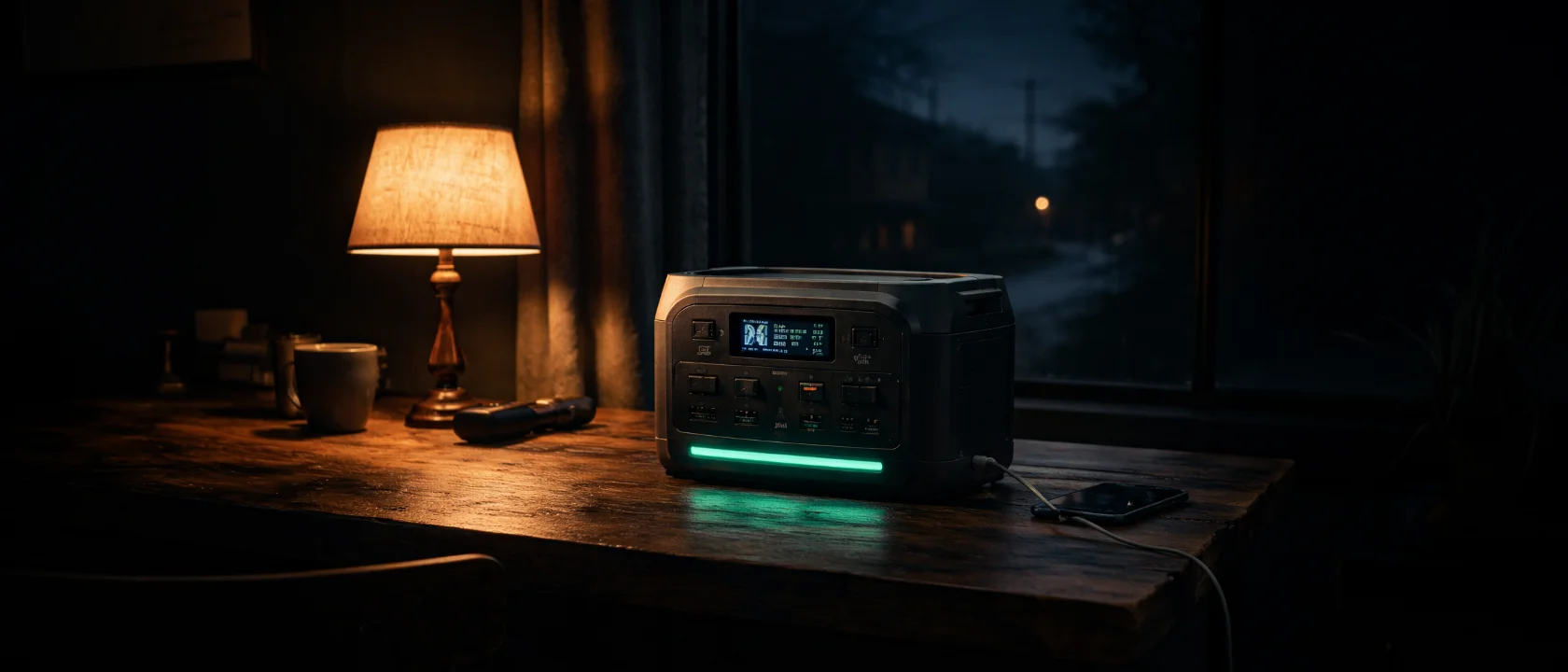
Can a power station help with emergency heating?
To a limited extent. A small power station (e.g. EcoFlow RIVER 2 with ~256 Wh) can run an oil-filled radiator at its lowest setting (500 W) for around 30 minutes – barely enough. For meaningful use, you need at least 1,000 Wh and an electric blanket (100 W) rather than an oil-filled radiator. Power stations are good for emergencies – but unsuitable as a primary heat source over several days.
# Quick Summary: Which Option for Which Situation
| Situation | Recommendation |
|---|---|
| Power available, heating broken | Oil-filled radiator + electric blanket |
| No power, 1–2 days | Thermal clothing, hot water bottle, sleeping bag, one room |
| No power, several days | Mr. Heater Buddy (window on latch + CO detector) or alcohol heater (Origo, if available) |
| Rented flat, long-term planning | Bioethanol fireplace (limited), discuss with landlord |
| Owner-occupied, long-term planning | Wood stove – the only real permanent solution |
The most important preparation costs little: a CO detector, an electric blanket and two layers of merino thermal underwear. That covers 90% of all heating failure scenarios without much effort.