When the power goes out, normal information channels collapse: smartphone battery dead, Wi-Fi down, no streaming. What remains is the radio – provided you have one that works without mains power.
Not every crank radio is equally suited for this. Anyone who only looks at “5,000 mAh” and “DAB+” misses the critical details: How long does the device actually last? What happens when the battery runs flat and there’s no power to charge it? And which radio can you take with you in a pinch?
Three devices compared – honestly, with concrete numbers.
# What Really Matters in an Emergency Radio
# Battery Capacity Isn’t Everything – Power Consumption Decides
A 5,000 mAh battery sounds like a lot. But how long it lasts depends on the device’s power consumption. Typical DAB+ radios draw 200–400 mA during operation. A radio with 5,000 mAh and 300 mA consumption will run for roughly 16 hours. FM reception is usually more efficient than DAB+, while Bluetooth streaming and bright torches draw more. Manufacturer figures (often 20–30 hours) typically apply at minimum volume without extras – in real use, expect half that.
# Cranking: Useful, But Not a Magic Solution
The hand crank is the emergency differentiator of these radios – and simultaneously the most misunderstood feature. The reality:
1 minute of cranking delivers roughly 1–5 minutes of radio operation. To listen for 10 hours, you’d have to crank for 2–10 hours. That’s unrealistic for continuous use. The crank is not a primary power source but a genuine last-resort backup: for that critical news bulletin when everything else is flat.
# Battery Backup Is More Important Than Solar
All devices in this comparison have a solar panel. The same applies to solar as to the crank: in practice, small built-in panels with 80–350 mA are enough to slow discharge or squeeze out a few extra hours in good light. Full recharging requires direct sunlight over several hours.
The more reliable backup is the battery compartment: anyone with AAA batteries (always a good idea in a go-bag) can keep the radio running immediately, without depending on sun or cranking.
Rule of thumb: In a blackout scenario – no power, bad weather, indoors – spare batteries are your safest plan. Solar and crank are valuable supplements, but not replacements.
# DAB+ or FM? And What Is EWF?
For emergency preparedness: both reception types matter, but FM is non-negotiable.
FM has near-universal coverage across Germany and most of Europe. The German Federal Office of Civil Protection (BBK) explicitly recommends a battery-powered FM radio for emergencies. A nationwide FM shutdown is not on the horizon.
DAB+ offers one decisive advantage: EWF (Emergency Warning Functionality). EWF-capable devices can be automatically woken from standby the moment an official emergency alert is broadcast over DAB+ – similar to Cell Broadcast on your phone, but independent of the mobile network. A DAB+ radio with EWF left on standby will actively alert you in a crisis without any action on your part.
Both reception types are available in all three devices in this comparison. Two of them additionally support EWF.
# Weight and Portability
At home, weight barely matters. But if you have a go-bag or want the radio for outdoor trips, look closely: the range here runs from 260 g to 704 g – almost twice the weight for the heaviest candidate. Dimensions also differ significantly.
# 1. Acta Berg DAB+/FM Crank Radio – Our Pick
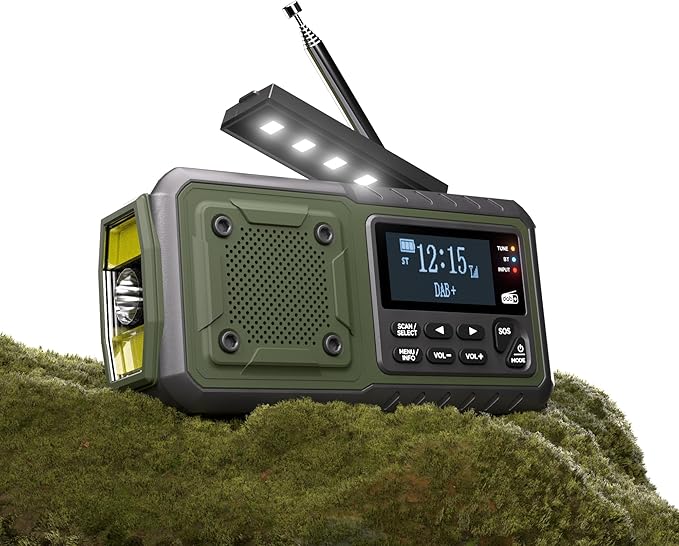
Acta Berg Kurbelradio DAB+/FM
★ Our PickThe Acta Berg is currently the most balanced emergency radio in this price bracket – and rated top in multiple independent 2026 tests. What sets it apart from the competition: it’s the only device in this comparison with EWF support alongside AAA battery backup.
Using EWF in practice: Leave the radio in standby – when an official warning comes via DAB+ (severe weather, disaster, blackout alert), it switches on automatically. No phone signal needed.
The 5,000 mAh battery provides 15–20 hours of DAB+ reception at moderate use. When it runs flat, 3× AAA batteries step in as instant backup. The torch delivers 400 lumens at maximum – a remarkable figure for a radio, genuinely useful in a blackout.
One clear downside: IPX0 – zero splash or moisture protection. Keep this device dry. In rain, on damp surfaces, or in bad-weather outdoor use, protect it in a bag or box.
Strengths: EWF ✓, AAA backup, 5,000 mAh, powerful torch (400 lm), Bluetooth, alarm, SOS, top-rated in tests. Weaknesses: IPX0 – no moisture protection, must be kept dry. Solar panel only supplements charging. Best for: Home emergency shelf, go-bag, camping.
# 2. Mesqool 12,000 mAh – Maximum Autonomy

Mesqool Kurbelradio DAB+ 12000mAh
✓ Best ValueIf you want maximum self-sufficiency, the Mesqool is hard to beat. The 12,000 mAh battery is more than twice the size of the Acta Berg’s – at moderate power consumption that’s realistically 35–45 hours of DAB+ operation without recharging. The solar panel at 8,500 mm² and 350 mA is the strongest in this comparison: in direct sunlight, it delivers genuinely meaningful charging power.
Add IPX6: the device withstands even heavy rain and is the only candidate here with real weather protection. The 2.4-inch TFT colour display isn’t just a gimmick – time, station and charge status are easily readable even in the dark.
The price: 704 grams. That’s no problem for a home base radio, but noticeable in a go-bag. And EWF is missing – anyone who wants the automatic emergency alert needs the Acta Berg instead.
Strengths: Largest battery (12,000 mAh), IPX6, strongest solar panel, colour display, Bluetooth 5.0, AAA backup. Weaknesses: No EWF. Heaviest device (704 g). Unknown brand without German warranty service. Best for: Home as a permanent station, outdoor camps, when multi-day autonomy is needed.
# 3. ration1 DAB+ Crank Radio – Compact for On the Go

ration1 DAB+ Kurbelradio
The ration1 is the lightest and most compact device in this comparison – 260 grams, just 15 × 4 × 7.5 cm. It disappears into any pocket and is the only option here you could genuinely carry every day. German brand, solid build quality.
The honest look at weaknesses: at ~€90, it’s the most expensive device in the comparison – and for that offers the smallest battery (2,000 mAh, realistically around 6–8 hours of normal use), the weakest solar panel (80 mA, barely measurable effect), no IP rating, and no EWF. The value proposition is explained by miniaturisation and brand positioning, not feature depth.
The ration1 isn’t the device for a multi-day home blackout – the Acta Berg or Mesqool are the better choice for that. Its unique selling point is extreme compactness: if you want a radio that lives permanently in your go-bag, glove box or jacket pocket and is instantly to hand in an emergency, this is the right device.
Strengths: Lightest device (260 g), smallest footprint (15×4×7.5 cm), DAB+/FM, AAA backup, Bluetooth, SOS, German brand. Weaknesses: Smallest battery (2,000 mAh), weakest solar. No IP rating, no EWF. Expensive for the features offered. Best for: Go-bag, glove box, everyday carry – wherever weight and size are the deciding factors.
# Which Radio for Whom?
For home emergency preparedness, the Acta Berg is the first choice: it has EWF (automatic alert in standby), a large battery, AAA backup for the worst case, and costs under €50. The EWF feature alone justifies the choice – no other device in this price range combines it with battery backup.
Anyone looking for a radio for multi-day outages or outdoor use who doesn’t want to compromise on any feature should take the Mesqool: 12,000 mAh and IPX6 are hard to beat. You’ll have to accept the weight.
The ration1 is the choice when weight and size decide – 260 g, jacket-pocket format, always there. The premium over the others is explained by miniaturisation, not more features.
Don’t forget: Regardless of which device – always keep a stock of AAA batteries ready. In a real blackout, that’s the most reliable backup, not solar or cranking.
The radio covers information – a power bank keeps your phone charged for emergency calls. Both belong in a complete home emergency plan.
What is the difference between DAB+ and FM for emergency radios?
FM (UKW) is the analogue broadcast system with decades of near-universal coverage across Germany. The Federal Office of Civil Protection explicitly recommends an FM-capable radio for emergencies. A nationwide FM shutdown is not planned.
DAB+ is the digital broadcast system with over 97% mobile coverage in Germany. It offers better sound quality and more stations – and crucially the EWF function (Emergency Warning Functionality), which can automatically wake the radio from standby when an official emergency message is broadcast. All three radios in this comparison receive both DAB+ and FM.
What is EWF and how useful is it in practice?
EWF (Emergency Warning Functionality) is a DAB+ feature that switches the radio on automatically when authorities broadcast an official warning – similar to Cell Broadcast on your phone, but independent of the mobile network. The radio must be in standby for this to work (draws minimal power).
In an emergency – severe weather, chemical incident, evacuation – this can be decisive: you receive the warning even if you’re asleep or your phone has no signal. The Acta Berg is the only device in this comparison that supports EWF.
How long can I really crank to power the radio?
The crank is a genuine emergency option, but not a comfortable primary power source. 1 minute of cranking delivers roughly 1–5 minutes of radio operation depending on the device. For one hour of radio, you’d need 12–60 minutes of cranking – which shows the crank is designed for short news updates, not continuous operation.
For a longer blackout, the right preparation is: keep the battery fully charged (charge the device regularly), and keep a stock of AAA batteries in your go-bag. Solar extends runtime noticeably in good light, but is also not a reliable primary source indoors or in overcast conditions.
Is the built-in solar panel useful in practice?
Not as a primary power source – the small built-in panels in this class are designed as a supplement. The weakest panel in the comparison delivers 80 mA (ration1), the strongest 350 mA (Mesqool). For comparison: the device draws 200–400 mA during operation – so the panel at best keeps up with consumption.
For serious solar charging you’d need direct sunlight over several hours. Indoors, in cloudy conditions, or with the radio in a bag, solar is practically ineffective.
Can I use the radio as a power bank for my phone?
Yes – all three radios in this comparison have a USB output and can be used as a power bank. The Mesqool with 12,000 mAh has the largest reserve for this and can charge a modern smartphone several times. The ration1 with 2,000 mAh manages a partial charge.
Note: if you use the radio as a power bank, it reduces radio runtime. Prioritise in a blackout – receive information (radio) or charge the phone for potential emergency calls.