When the power goes out, preparedness comes down to what you have at hand. A power station in the 2000 Wh class can run router, lights, phones and a fridge for 1–2 days – silently, without fumes, without fuel. Add solar and you extend that considerably.
All four devices in this comparison meet the baseline for serious emergency preparedness: LFP battery (3000+ cycles), 2000+ Wh capacity, solar input and at least 2200 W continuous output. What separates them is price, weight and specific strengths.
For a full explanation of what the specs mean and how to choose the right capacity, see the buying guide: Buying a Portable Power Station.
# 1. EcoFlow DELTA 3 Max – The Market Leader

EcoFlow DELTA 3 Max
★ Our PickEcoFlow is the most recognised brand in the power station market – and the DELTA 3 Max shows why. 2048 Wh, 2400 W continuous output (X-Boost up to 4800 W), 0–80% in 51 minutes. LFP battery with 3000 cycles. 1000 W solar input. Expandable with the DELTA 3 Max Plus to 4 kWh total capacity.
X-Boost technology is a genuine advantage: it allows running devices with up to 4800 W startup demand by adjusting frequency. It works well for most household appliances – fridge, microwave, small tools.
UPS function: The DELTA 3 Max switches to battery in under 30 ms when mains power fails. Routers, NAS drives or medical devices won’t notice the outage.
Strengths: Fastest charging (51 min to 80%), proven ecosystem, UPS function, X-Boost, expandable to 4 kWh. Weaknesses: Most expensive in the comparison. Solar input at 1000 W not the highest. Exact weight not officially stated (~23 kg). Best for: Anyone who wants the best-known brand with the strongest ecosystem and fastest charging.
# 2. BLUETTI Elite 200 V2 – Best Value

BLUETTI Elite 200 V2
✓ Best ValueThe BLUETTI Elite 200 V2 offers the highest continuous AC output in the comparison: 2073 Wh, 2600 W continuous output (power lifting to 3900 W), 1200 W solar input – the highest in the comparison. It also charges fastest: 0–80% in 45 minutes.
At ~€1,099 it’s €200 less than EcoFlow (€1,299) and around €80 less than Anker (€1,180) – while delivering more continuous output and more solar input. It’s more expensive than the Jackery, but significantly more capable.
BLUETTI states a service life of 17 years (3500 cycles to 80% capacity). This is one of the longest claims in the category.
Strengths: Highest AC output (2600 W), highest solar input (1200 W), fastest charging (45 min), cheaper than EcoFlow and Anker, excellent stated lifespan. Weaknesses: Heaviest device (24.2 kg). Less brand recognition than EcoFlow or Jackery. Best for: Anyone who wants maximum output and solar capacity without paying the EcoFlow premium.
# 3. Jackery E2000 v2 – The Lightest Option

Jackery E2000 v2
Jackery is one of the oldest and most recognised brands in the segment, and the E2000 v2 is their current flagship in the 2 kWh class. 2042 Wh, 2200 W continuous output (4400 W peak), 0–80% in 52 minutes. LFP battery. 800 W solar input.
The defining differentiator: at 17.5 kg, the E2000 v2 is the lightest device in the comparison – 6–7 kg less than BLUETTI and EcoFlow. Anyone transporting the station regularly (camping, car, motorhome) will feel that difference.
Jackery has an excellent reputation for ease of use: clean interface, clear display, reliable app.
Strengths: Lightest device (17.5 kg), trusted brand, easy operation, 4400 W peak, fast charging (52 min to 80%). Weaknesses: Lowest solar input in the comparison (800 W). Lowest continuous output (2200 W). Price (~€899) higher than BLUETTI. Best for: Anyone who transports regularly and wants a light, reliable device from a well-established brand.
# 4. Anker SOLIX C2000 Gen 2 – Versatile and Expandable
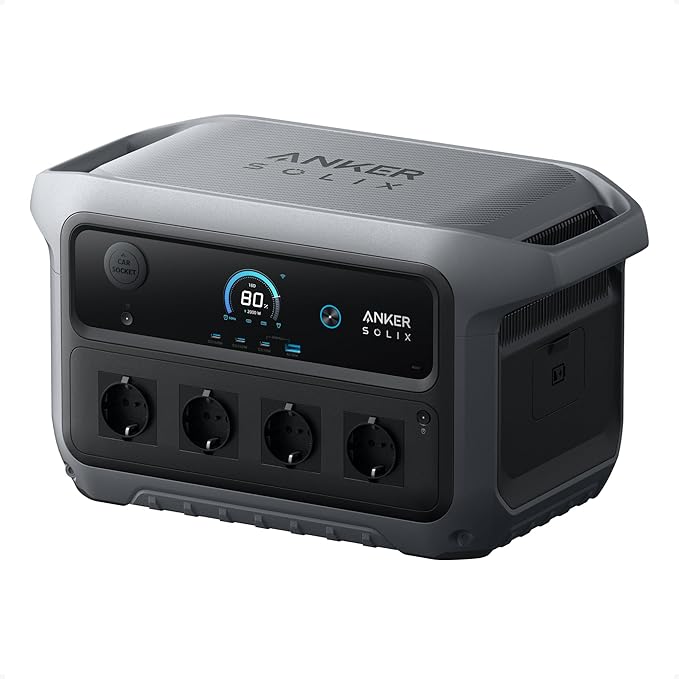
Anker SOLIX C2000 Gen 2
The Anker SOLIX C2000 Gen 2 is the most versatile device in the comparison: 2048 Wh, 2400 W continuous output (4000 W peak), 100% in 58 minutes, 6 charging methods including 800 W alternator charging (directly from your car). Expandable to 4 kWh with an add-on battery. 18.9 kg – the second lightest.
Alternator charging from the car is a genuine advantage for camping and motorhome users: 800 W while driving charges the station fully in ~2.5 hours.
Anker is known for quality electronics and delivers a device that competes on price with EcoFlow while adding modularity and flexibility.
Strengths: Expandable to 4 kWh, 6 charging methods (including 800 W alternator), 18.9 kg (second lightest), 1000 W solar input, Anker build quality. Weaknesses: €120 more than BLUETTI, though cheaper than EcoFlow. Slightly lower continuous output than BLUETTI. No X-Boost or Power Lifting equivalent. Best for: Anyone who prioritises flexibility and expandability, travels frequently by car and values Anker’s quality reputation.
# Head-to-Head
| EcoFlow DELTA 3 Max | BLUETTI Elite 200 V2 | Jackery E2000 v2 | Anker SOLIX C2000 Gen 2 | |
|---|---|---|---|---|
| Capacity | 2048 Wh | 2073 Wh | 2042 Wh | 2048 Wh |
| AC output | 2400 W | 2600 W | 2200 W | 2400 W |
| Peak | 4800 W | 3900 W | 4400 W | 4000 W |
| Charge 0–80% | 51 min | 45 min | 52 min | ~46 min |
| Solar input | 1000 W | 1200 W | 800 W | 1000 W |
| Weight | ~23 kg | 24.2 kg | 17.5 kg | 18.9 kg |
| Price | ~€1,299 | ~€1,099 | ~€899 | ~€1,180 |
| Expandable | ✓ (4 kWh) | ✓ | ✓ | ✓ (4 kWh) |
| UPS | ✓ (<30 ms) | ✓ | ✓ | ✓ |
| Battery type | LFP | LFP | LFP | LFP |
# Our Recommendations
Best value: The BLUETTI Elite 200 V2 – highest continuous output (2600 W), highest solar input (1200 W), fastest charging (45 min), cheaper than EcoFlow and Anker. Anyone looking for the best value will find it here.
Best overall: The EcoFlow DELTA 3 Max – fastest charging, best ecosystem, UPS function, X-Boost. The best-selling power station in this class for good reason.
Best for portability: The Jackery E2000 v2 – 17.5 kg is 5–6 kg less than the competition. If you carry it regularly, this matters.
Best for versatility: The Anker SOLIX C2000 Gen 2 – 6 charging methods, 800 W alternator charging, expandable to 4 kWh.
# Frequently Asked Questions
Which power station for home blackout preparedness?
For most households, the BLUETTI Elite 200 V2 is the smartest choice: lowest price, highest continuous output, highest solar input. If brand recognition and fastest charging matter more, go with the EcoFlow DELTA 3 Max.
Is a power station enough for a fridge?
Yes – all four devices handle it. A typical fridge draws 80–150 W in operation and 400–600 W at startup. With 2200–2600 W continuous and 3900–4800 W peak output, no problem. How long it lasts depends on the fridge’s consumption and the station’s capacity: at 100 W average and 2000 Wh, the station runs for ~20 hours.
How much does a solar setup cost?
A 200 W solar panel costs €150–250. With it you can fully charge the station in roughly 8–12 hours (depending on sunlight). Two panels (400 W) halve that time. EcoFlow and Jackery sell compatible panels directly – third-party panels work too with the right connector.
Can I use the station while it's charging?
Yes – all four devices support pass-through operation: you can run appliances while the station charges. This works best when connected devices draw less power than the station is receiving.
How long does solar charging take?
With 1000 W solar input and full sun: ~2 hours to 100%. In practice (partial cloud, angle, diffuse light): 4–8 hours. With a single 200 W panel: 8–12 hours.