An emergency backpack isn’t something you buy and forget. It needs to sit in storage for years, be ready to grab immediately – and then carry comfortably for hours or days. What matters isn’t just the material, but also how quickly you can find the right thing under stress.
We compared five models between 25 and 37 liters across all budgets, evaluated against real manufacturer specifications. No single backpack fits everyone – but there’s a clear recommendation for each profile.
# What Actually Matters
Volume: 25–35 liters is the sweet spot for one person and 72 hours. Below that you run out of space; above that the pack becomes too heavy. The 5.11 Rush 24 2.0 sits slightly above at 37 liters – packed efficiently, it works well.
Compartments and access speed: A good emergency backpack has multiple separate access points. Flashlight, first aid, water, and documents need to be reachable fast – without digging through the entire bag. This is the most important practical difference between a hiking backpack and an emergency backpack.
Material: 500D+ Cordura or 1050D nylon for maximum durability. Standard 600D polyester is fine for dry storage but significantly less abrasion-resistant.
Carrying system: A padded hip belt and ventilated back panel are mandatory above 8 kg – not a comfort feature, but a safety one. A poorly fitting pack is a liability in an emergency.
Daily usability: The best emergency backpack is one you know and use regularly – not one that sits untouched in the basement.
# 1. Osprey Stratos 34 – Best Access System

Osprey Stratos 34 Wanderrucksack
★ Our PickThe Osprey Stratos 34 is the pack in this comparison best designed for fast access to the right gear. Six distinct storage zones: main compartment (top), a separate bottom compartment (own zipper), a vertical front pocket with organizer, large zippered pockets on both hip fins (smartphone-sized), stretch side pockets for water bottles, and a lid pocket. That means: flashlight up front, first aid in the bottom compartment, water on the side, documents in the lid pocket – everything within reach, nothing needs to be reorganized.
The AirSpeed back system keeps pack and back separated via a tensioned mesh – similar to Deuter’s Aircomfort system, but with better overall organization. Rain cover is included from factory, PFAS-free DWR coating. Material is Bluesign-certified recycled nylon.
At ~€140 it’s the second most affordable premium pack in the comparison. Limitation: no Cordura, no MOLLE – anyone needing tactical expandability should go with the TT or 5.11.
Strengths: Best pocket layout for emergency use, AirSpeed ventilation, hip belt pockets, rain cover included, lighter than TT and 5.11. Weaknesses: No Cordura, no MOLLE, not expandable. Civilian look – advantage for some, disadvantage for others. Best for: Anyone wanting a well-organized pack with fast access – and no need for a tactical aesthetic.
# 2. Tasmanian Tiger TT Modular Pack 30 – German Premium

Tasmanian Tiger TT Modular Pack 30
Tasmanian Tiger is a Munich-based brand whose packs are used by military, police, and special units in Germany and worldwide. The TT Modular Pack 30 is the flagship model in the lineup – a backpack built for decades of use.
700D Cordura combines the tear strength of 1000D fabric with the weight of a 500D model, according to the manufacturer. The full clamshell opening (opens completely flat) gives instant overview of all contents. The Laser-Cut MOLLE system on front and sides has no fabric loops – cleaner outer surface, fewer abrasion points. Inside: loop panels with three included pouches for flexible organization. Removable hip fins with zippered pockets.
Official retail price according to the manufacturer: €245. Typically available cheaper on Amazon.de, often around ~€160. Not a bargain – but a backpack that will still work perfectly in 20 years.
Strengths: 700D Cordura (most robust material in comparison), full clamshell opening, Laser-Cut MOLLE, German brand product, proven in professional use. Weaknesses: Most expensive pack in the comparison. At 1,650 g (empty) slightly heavier than Osprey and Mardingtop Cordura. No ventilated back system. Best for: Anyone unwilling to compromise on quality and prepared to pay for it. Also well-suited for professional use (emergency services, security, fire service).
# 3. 5.11 Rush 24 2.0 – Maximum Organization
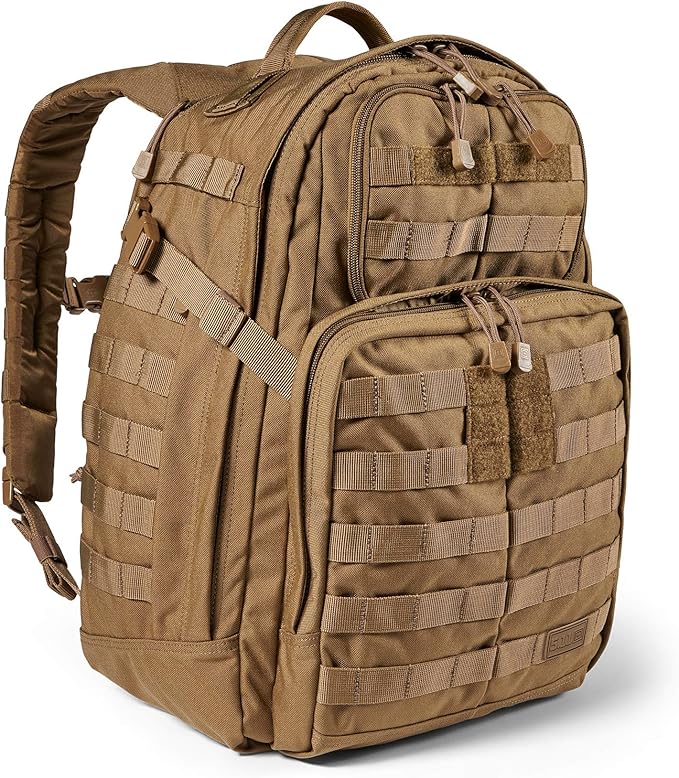
5.11 Rush 24 2.0 Rucksack (37 L)
The American classic among tactical backpacks. 1050D nylon is the densest civilian nylon weave on the market – denser than 700D and 915D Cordura. The access system is the most comprehensive in the comparison: two padded main compartments, fleece-lined eyewear pocket, padded laptop sleeve (ideal for documents in a waterproof sleeve), 2-liter hydration sleeve, and a hidden rear compartment for documents or EDC gear. The MOLLE system is the most extensive here: front, sides, shoulder straps, hip fins – everything modularly expandable.
37 liters sits slightly above the 35-liter recommendation but in practice packs more efficiently than many nominally smaller bags. Weight: 1,740 g.
Strengths: 1050D nylon (most robust material in comparison), most extensive MOLLE system, best tactical compartment layout, hidden document pocket. Weaknesses: Military aesthetic – conspicuous in civilian evacuation scenarios. Heaviest pack in the comparison. 37 liters borderline for lighter packing. Best for: Preppers, tactical users, and anyone wanting a comprehensive organizational system with maximum durability.
# 4. Mardingtop 35L Cordura – Best Value

Mardingtop 35L Tactical Rucksack (Cordura)
✓ Best ValueThis is the surprise of the comparison: 915D Cordura for ~€75. That’s denser than the 500D fabric of the Wisport Sparrow and comparable to the 700D Cordura of the Tasmanian Tiger – at a fraction of the price. Add to that YKK zippers and YKK buckles – the same standard used by TT and Wisport. Mardingtop publishes complete technical data for every model on their website (mardingtop.com) – transparent, which is rare for Chinese brands.
35 liters hits exactly the recommended volume. MOLLE throughout, hydration sleeve, adjustable hip belt, padded back system. Lightest Cordura pack in the comparison: 1,340 g.
Limitation: no long-term customer reviews over many years, no established reputation like TT or Osprey. Anyone who needs brand assurance will prefer to pay more.
Strengths: 915D Cordura + YKK for ~€75, lightest Cordura pack, exactly 35 L, MOLLE system. Weaknesses: New brand without long-term track record, no ventilated back system, no separate bottom compartment. Best for: Anyone wanting Cordura quality without spending €130–160. The clear upgrade from the budget model.
# 5. Mardingtop 25L – Compact Budget Entry

Mardingtop 25L Taktischer Rucksack
The most affordable model in the comparison – and the smallest. 25 liters is the absolute minimum for a 72-hour bag: it works, but you’ll need to prioritize and skip some comfort items. Material: 600D polyester – not Cordura, but sufficient for dry storage and occasional use.
MOLLE throughout, hydration sleeve, hip belt, multiple external pockets – for ~€45 that’s a solid package. But the direct comparison makes it clear: if you have the budget, step up to the Mardingtop 35L Cordura for ~€75. 10 more liters, Cordura material, and YKK zips for €30 more are almost always worth it.
Strengths: Cheapest entry point (~€45), MOLLE present, hip belt, compact and light. Weaknesses: 25 L at the lower limit, no Cordura, no separate bottom compartment. Significantly less volume than the rest. Best for: Tight budget or secondary bag for family members. Anyone who can afford it should get the 35L Cordura model instead.
# Our Recommendation
Best access system / top pick: The Osprey Stratos 34 – six storage zones, hip belt pockets, rain cover, ventilated back system. The best choice for most people.
German premium: The Tasmanian Tiger TT Modular Pack 30 – 700D Cordura, professional quality. No compromises.
Tactical organization: The 5.11 Rush 24 2.0 – 1050D nylon, hidden document pocket, MOLLE on every surface.
Best value: The Mardingtop 35L Cordura – 915D Cordura, YKK zips, 35 L for ~€75.
Entry level / compact: The Mardingtop 25L – solid start, budget-friendly. Upgrade to the Cordura model if you can.
What matters more than the pack is what goes inside. The complete packing guide: → Emergency Bag Packing: What Really Goes In
# Frequently Asked Questions
How many liters does an emergency backpack need?
For one person and 72 hours, 25–35 liters is the sweet spot. Below that you have to make too many sacrifices; above that the pack becomes dangerously heavy when fully loaded. If packing for two people, use two separate 25–30 liter bags.
What is Cordura and why is it better?
Cordura is a registered trademark fabric from Invista – particularly abrasion-resistant and tear-resistant nylon. 500D, 700D, or 900D indicates yarn density: higher = denser = more robust. Standard 600D polyester is softer and cheaper, but significantly less resistant to abrasion and extreme conditions.
Do I need a MOLLE system?
MOLLE allows attaching additional pouches. Useful if you want to expand the pack modularly over time. Not essential for a well-packed basic bag – but a practical option for anyone wanting to carry a lot of equipment flexibly.
How heavy should a fully packed emergency bag be?
No more than 15–20% of your body weight. For a 70 kg person, that’s a maximum of 10–14 kg. A fully packed 72-hour bag for one person realistically lands at 8–12 kg. A padded hip belt is mandatory above 8 kg – not optional, but safety equipment.
Why is Tasmanian Tiger so expensive?
TT manufactures in their own facility in Germany and Europe under strict quality controls, uses Cordura and YKK from the start, and supplies professional customers including military and police. The higher price reflects real production costs – and a backpack that will still look like new in 20 years.
What color should an emergency backpack be?
Subdued colors (black, grey, olive green, dark blue) are smarter in evacuation situations – you don’t advertise that you’re well-equipped. Bright colors and camo patterns signal unnecessarily that you have valuable gear.