Smartphones are the first thing to fail in an emergency. When cell towers are overloaded or without power, anyone who wants to communicate needs a radio – and the right knowledge about what they are legally allowed to do with it.
This comparison covers four devices across two categories: license-free PMR446 walkie talkies for immediate use without any exam, and amateur radio handhelds for those who hold or are pursuing a license. Everything you need to know about the legal situation, the amateur radio exam, and why AA batteries matter is covered in our guide to radio communication.
# PMR446: License-Free, Ready Immediately
PMR446 is the EU-wide standard for license-free short-range radio. No exam, no registration – buy and transmit, as long as the device is CE-certified and stays within the permitted 0.5 watts.
# 1. Midland G9 Pro – Best for Emergency Preparedness

Midland G9 Pro
★ Our PickThe G9 Pro is the most well-thought-out PMR device for emergency preparedness. AA batteries included – no proprietary pack that eventually becomes unavailable. The built-in FM radio receives public broadcaster announcements when the internet is down. At IPX4 it is splash-resistant and handles rain without issue. Note: it is sold as a single unit – budget for two to actually communicate (~€160 for a pair).
The channel scan automatically searches all 16 channels for activity, and the emergency alert tone triggers all paired devices simultaneously. Exactly what you want in a crisis.
Strengths: AA batteries, IPX4 splash-resistant, FM radio, emergency tone, approved across Europe. Weaknesses: Larger and heavier than compact alternatives. Urban range realistically 1–3 km. Range: Up to 12 km (manufacturer claim, open terrain) / 1–3 km (realistic, built-up areas).
# 2. Motorola T82 Extreme – The Familiar Option
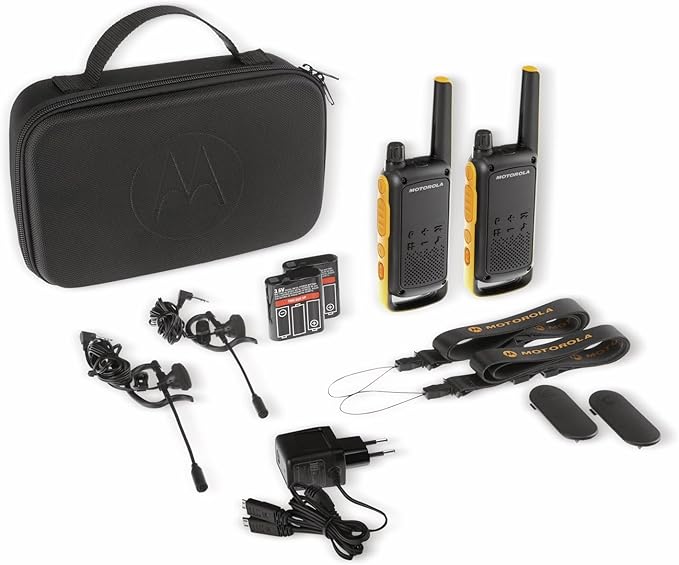
Motorola T82 Extreme
✓ Best ValueThe T82 Extreme is the best-selling PMR device in Europe, available in many hardware stores. Robust housing, IPX4 weather resistance, straightforward operation. A solid choice for occasional outdoor use.
For emergency preparedness, it has two weaknesses: the built-in NiMH battery is not easily swappable – without power, the charger is useless. An AA battery holder is available as an accessory, but must be purchased separately. It also lacks an FM radio receiver.
Strengths: Twin pack (~€75), widely available, IPX4, simple operation, solid build quality. Weaknesses: No FM radio, NiMH battery (AA backup only with separate holder), no dedicated emergency tone. Range: Up to 10 km (manufacturer claim) / 0.5–2 km (realistic, built-up areas).
# Ham Radio: Significantly More Range With a License
Anyone with a Class E amateur radio license may transmit on VHF/UHF bands with up to 100 watts and use repeaters – installations that receive your signal and retransmit it with greater range. In practice: 30–50 km in a city via urban repeaters, instead of 1–3 km with PMR. A significant difference when it matters.
Without a license, these devices may only be used for receiving.
→ Everything about the license, the exam, and costs: Amateur Radio Guide
# 3. Baofeng UV-5R – The Entry Point for Licensed Operators

Baofeng UV-5R
✓ Best ValueNo other amateur radio handheld is as widely used as the UV-5R. It is the standard among beginners worldwide and in many emergency radio groups. Dual-band (VHF 144 MHz + UHF 430 MHz), FM radio, programmable via the free CHIRP software.
For around €5, a 6×AA battery pack transforms the UV-5R into a true emergency device that remains operational without mains power:
 HYS 6×AA Batteriepack für Baofeng UV-5R~5 €View →
Build quality is acceptable for the price, but not comparable to Yaesu or Kenwood.
Legal note: In Germany, the UV-5R may only be used to transmit with a valid amateur radio license. It is not PMR446-compliant and may not be used as a PMR radio. Without a license, it may only be used as a receiver.
Strengths: Very affordable, dual-band, FM radio, AA pack available, huge community, CHIRP-compatible. Weaknesses: No IP rating, average build quality, non-intuitive controls without reading the manual. No German warranty service. Transmit power: 1 W / 5 W (switchable).
# 4. Yaesu FT-60R – The Reliable Workhorse

Yaesu FT-60R
★ Our PickThe FT-60R has been a trusted recommendation in the amateur radio community for years for anyone wanting a robust handheld for emergency use. Splash-resistant, solid aluminium chassis, intuitive controls – and one of the best receiver sensitivities in its class.
It receives a wide frequency range (108–520 MHz and 700–999 MHz), including aviation, weather radio, and FM broadcasts. The included battery can be replaced with an AA battery holder for genuine energy independence in emergencies.
Strengths: Excellent receive sensitivity, wide frequency coverage, splash-resistant, AA option, long community track record, Japanese build quality. Weaknesses: Price (~€130), limited Amazon.de availability (may need specialist retailer). No USB-C charging. Transmit power: 0.5 W / 2.5 W / 5 W (switchable).
# Which Device for Which Purpose?
For first emergency equipment with no prior knowledge, the Midland G9 Pro is the right choice: immediately usable, no license, AA batteries, FM radio.
Anyone who has or is planning an amateur radio license should pick up a Baofeng UV-5R as an affordable entry into ham radio alongside a PMR device – and upgrade to the Yaesu FT-60R when build quality and receiver performance become more important.
Can I use the Midland G9 Pro and the Baofeng UV-5R together?
No – PMR446 and amateur radio use different frequencies and cannot communicate with each other. Both devices are designed for different scenarios: PMR for license-free short-range communication, ham radio for licensed long-range communication via repeaters.
How long do AA batteries last in a PMR radio?
In the Midland G9 Pro, a set of AA alkaline batteries lasts 10–20 hours depending on usage intensity. In standby (receiving, rarely transmitting) significantly longer. Quality batteries from Energizer or Duracell are essential here – cheap batteries drain faster and perform poorly in the cold.
Can I use the Baofeng UV-5R on PMR446 frequencies?
No. The UV-5R is technically not PMR-compliant (wrong channel spacing, not limited to 0.5 W). Operating on PMR frequencies with the UV-5R is illegal in Germany without an amateur radio license.